Mural Art Pedagogy & History
CCA's legacy of mural art is deeply tied to the college’s social justice pedagogical origins. After Michael Oshoosi Wright established the Black Studies dept in 1968 (the first at an art college in the country, second after San Francisco State University), the mural wall was built on the Oakland campus shortly after to provide a structured, curriculum-based mural environment that bridged the gap between classroom theory and community-facing art.
The mural wall of Martinez Hall at CCA’s Oakland campus served as a vital public forum for community dialogue and aesthetic expression for more than five decades. This prominent west-facing wall hosted rotating, curriculum grounded murals that functioned as canvases for the college's evolving social and political concerns.
Mural Art History
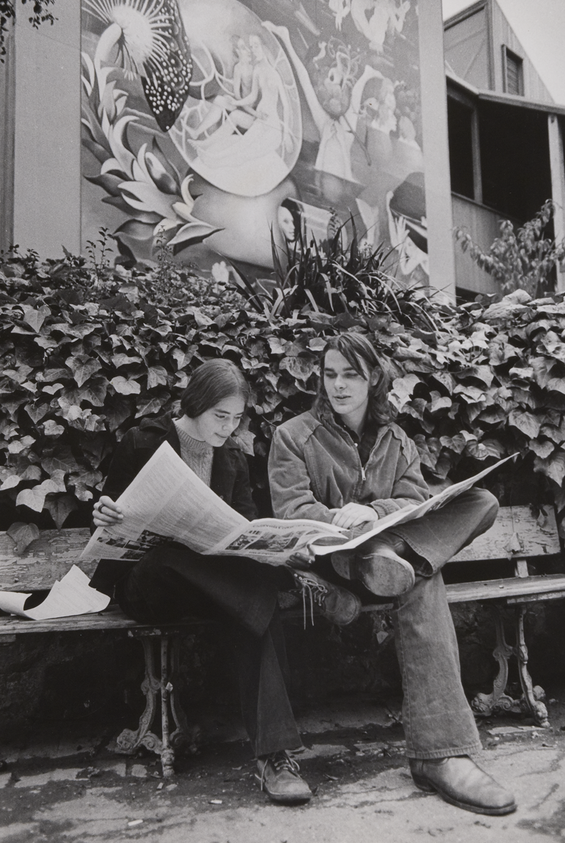
The tradition of muralism at CCA—originating at the Oakland campus—has functioned as a core pedagogical tool for over five decades, bridging classroom theory with community-engaged practice.
- 1968–1970s: Social Justice Origins
Following Michael Oshoosi Wright’s 1968 establishment of the first Black Studies department at an art college in the United States, the Martinez Hall mural wall was inaugurated as a structured site for public dialogue. During this era, murals were used as direct responses to the revolutionary political climate, often featuring iconic symbols of protest such as sunbursts and raised fists to ground the campus in social and political discourse.
- 1980s: Formalized Research and Community Engagement
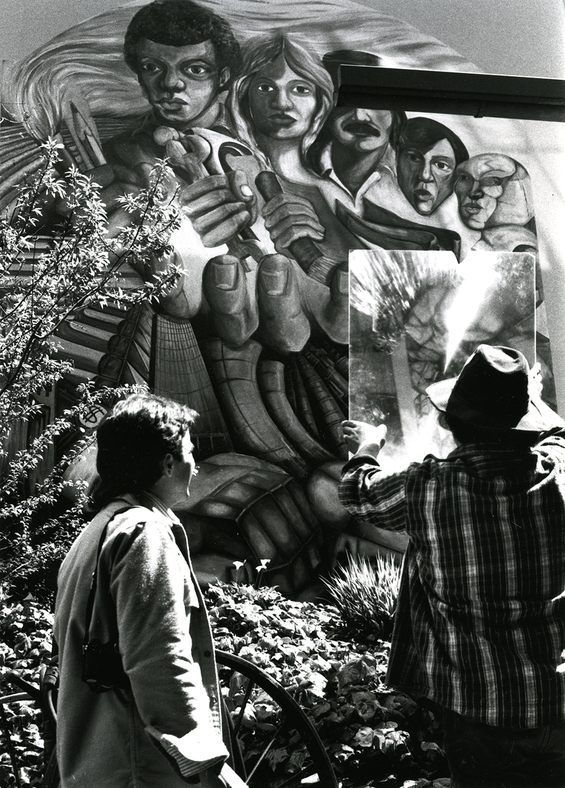
The practice gained significant academic rigor with the introduction of the "Mexican Muralism" course in 1981, taught by Jose Galindo, which shifted production to research-driven work. Malaquias Montoya further transformed this legacy by developing the "Mexican and Chicano Public Art" curriculum. Under his guidance, the wall became a forum to explore complex themes such as settler colonialism, indigenous land sovereignty, and regional conflicts. Notable projects included a 1988 collaboration with Professor Steven Ajay’s literature and poetry class, which used layered narratives to address Central American political conflicts, as well as work centered on themes of censorship and self-determination.
- 1990s–2000s: Sustaining Theory and Practice
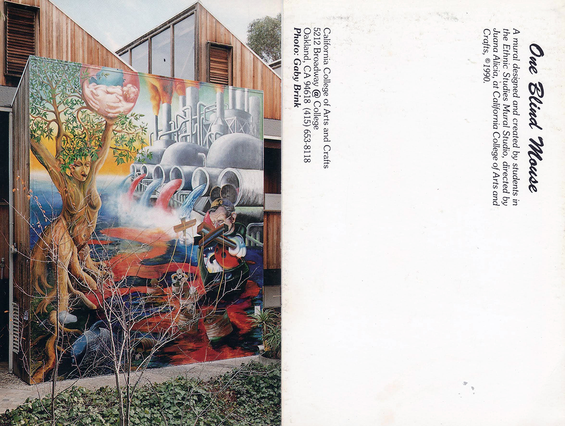
Throughout these decades, the mural wall remained a persistent pedagogical tool that reflected CCA’s foundational motto of “Theory and Practice.” The mural wall continued to bridge classroom curriculum with student-led interventions, maintained as a site for public conversation about evolving social and political concerns. The wall was established on campus as a generative space for creative labor.
- 2010s: Synthesizing Narrative and Historical Consciousness
This decade marked the conclusion of the Martinez Hall mural wall's history. It culminated in the 2015 Califia mural, directed by Eduardo Pineda. This final project served as a powerful synthesis of the era, combining the iconography of the Virgin of Guadalupe with the legendary figure of Califia to create commentary on creativity, justice, and nature. When CCA unified in San Francisco in 2022, this half century of mural legacy, centered on the Martinez Hall wall, transitioned to San Francisco and the incredible findings found through the bore samples.
San Francisco Grounding

California Quail
Callipepla californica

San Francisco Garter Snake
Thamnophis sirtalis tetrataenia

Peregrine Falcon
Falco peregrinus
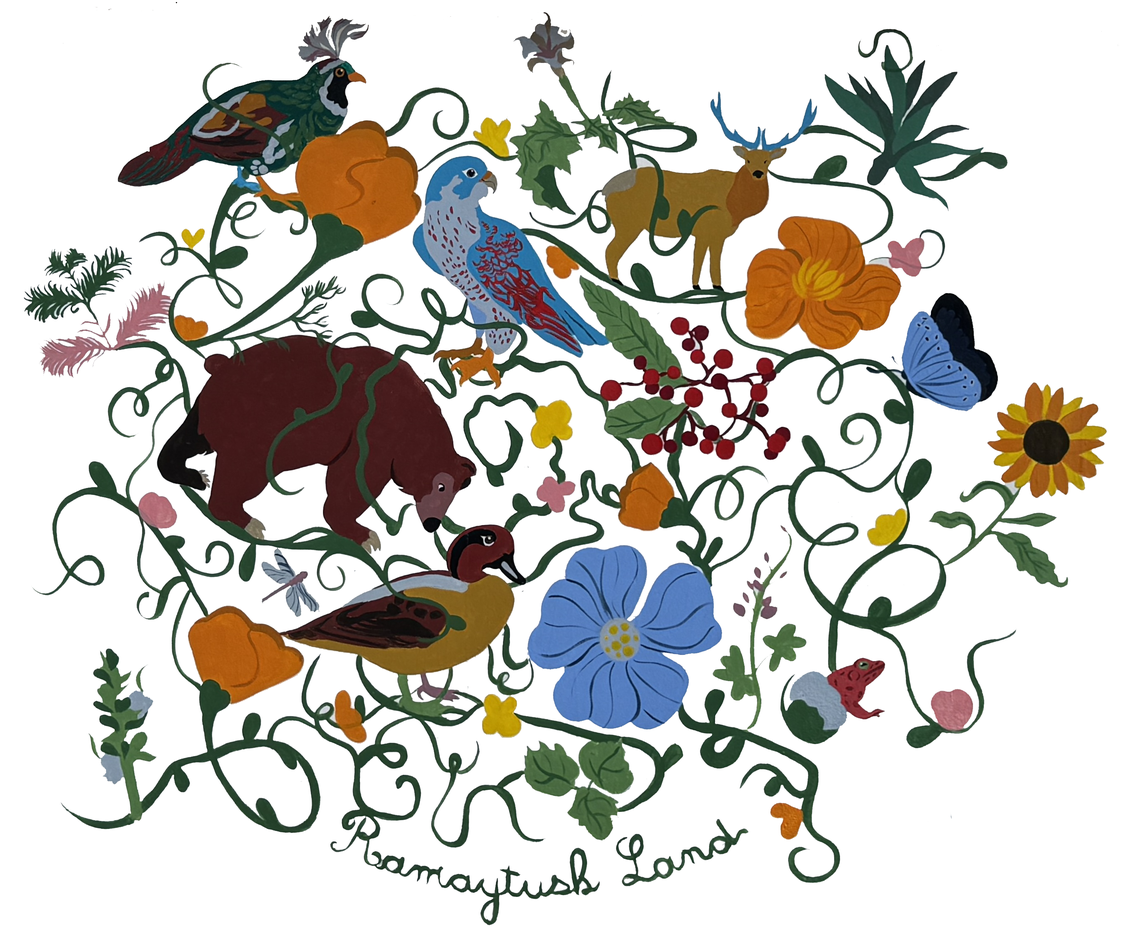
Working in partnership with Dr. Jonathan Cordero as cultural advisor, and the ARO (Association of Ramaytush Ohlone), the land acknowledgment was developed with care, consultation, and respect for the original people of the San Francisco Peninsula. Dr. Cordero’s guidance helped ensure that the imagery, language, and symbolism were used appropriately and with cultural sensitivity. Artist Vanessa Shive's role was to translate his ideas into visual form.
The artwork shows a clockwise spiral vine inspired by traditional basketry. Interwoven throughout the vines are plants and animals that hold ecological and cultural significance in the region. The flora includes flora found in the bore samples - Toyon, White Sage, California Poppy, Blue Flax, Common Sunflower, Jimsonweed, Arroyo Lupine and California Fuchsia. The fauna represented include Grizzly Bear, Tule Elk, Green-winged Teal, California Quail, Peregrine Falcon, Mission Blue Butterfly, Red-legged Frog, and the California Darner dragonfly.
Together, the collaborative process and the visual elements create a land acknowledgment that is not only spoken but embodied, rooted in cultural knowledge and brought forward through respectful artistic dialogue with Dr. Cordero.