
Under the Guard Tower: A CCA@CCA Exhibition Companion
The following teaching modules are designed to accompany visits to the exhibition Under the Guard Tower: The Watercolors of Chikaji Kawakami, curated by Senior Adjunct Professor and CCA@CCA Faculty Coordinator Lydia Nakashima Degarrod. Under the Guard Tower: The Watercolors of Chikaji Kawakami is on view at the CCA Campus Gallery at 1480 17th Street, Wednesday 11 am–7 pm, Thursday–Friday 11 am–1 pm, and by appointment, April 1–May 16, 2026.
Under the Guard Tower is part of the Spring 2026 Deborah and Kenneth Novack Creative Citizens Series, which includes public programming that addresses the 2026 CCA@CCA theme, Hope As Movement. How do we cultivate hope to fight the paralysis created by fear? How can we use the act of hoping to envision and create different futures?
The exhibition consists of 39 paintings made by Chikaji Kawakami (1882–1949, born in Kagoshima, Japan), who created art to document his life and elevate his spirits while incarcerated at internment camps at Tanforan and Topaz during WWII. Kawakami's artwork is an example of hope as movement; instead of being paralyzed by fear, he chose to respond to his incarceration by using art to portray himself and his fellow inmates with dignity and to find beauty and peace in nature. Kawakami's response is what South Korean philosopher Byung-Chul Hal defines as hope—not merely optimism, but the ability to imagine and move towards something more profound.
The exhibition also includes four paintings by Chiura Obata, a Japanese artist who founded and developed the art schools at Tanforan and Topaz, where Kawakami and other artists of Japanese descent taught.
These teaching modules aim to provide an understanding of life in internment camps for people of Japanese descent during WWII, and encourage reflection on the power of artwork to mobilize hope.
Each module includes a short introduction, an activity, and a set of questions to guide visitors in meaningful discussion. The modules are designed to be completed in under an hour at the gallery. Some also provide a list of suggested articles, books, and videos to further understanding of the material covered. These resources can be assigned as preparation or follow-up to a gallery visit. Some of this material can be obtained through the CCA library or interlibrary loan, or downloaded directly from journals or websites.
→ Download the Under the Guard Tower Teaching Modules as a PDF
Summary of Contents
Modules 1–3 address issues associated with the visual representation of everyday life in the camps. To facilitate the interpretation of Kawakami's paintings and his point of view, these modules feature the artwork of camp fellow and artist Miné Okubo, offering the perspective of a young woman and a Nisei, or member of the first generation of Japanese children born and raised in the United States.
- Module 1 / Depicting Life at the Camps: Compare and contrast how Chikaji Kawakami and Miné Okubo depict everyday life in Japanese American internment camps, and analyze how factors such as age, gender, cultural background, and citizenship status shape artists' perspectives on shared historical experiences.
- Module 2 / Self-Representation: Evaluate how artists such as Chikaji Kawakami and Miné Okubo use self-representation to challenge propaganda, and examine how artistic choices can function as acts of resistance, identity formation, and testimony.
- Module 3 / The Killing of James Wakasa: Analyze and compare multiple artistic representations of the death of James Wakasa to understand how historical events can be interpreted differently through art, and evaluate how cultural perspective, creative style, and intended audience shape the meaning and impact of visual responses to injustice and violence.
Modules 4–5 address the representation and role of nature at the camps.
- Module 4 / Nature and Memory: Reflect on Chikaji Kawakami's use of landscape during incarceration and create a visual response that connects personal experience or imagination to historical context. Examine how nature, memory, and imagination function as sources of emotional resilience.
- Module 5 / Gardening and Nourishment: Analyze how gardening functioned as a means of physical sustenance, emotional comfort, and cultural continuity in the camps by interpreting Chikaji Kawakami's artwork and connecting historical practices of food and cultivation to personal experiences of nourishment, memory, and well-being.
Module 6 addresses the role of art schools at the camps in fostering community and healing.
- Module 6 / The Role of Art Schools: Analyze artworks created in Japanese American incarceration camps to understand how artistic practice can function as a form of personal agency and community-building during times of trauma.
Module 7 invites the exhibition's audience to deepen their understanding of life at the camps by listening to recordings of ex-inmates' personal narratives.
- Module 7 / Oral Histories: Engage with oral histories and visual artworks to deepen understanding of daily life in the Topaz incarceration camp, and to understand how lived experience, memory, and resilience are communicated through multiple forms of storytelling.
Background Information
On December 7, 1941, President Franklin Delano Roosevelt issued Executive Order 9066, which forced the evacuation and detention of all people of Japanese descent living on the West Coast of the United States. Over 120,000 people of Japanese descent, of which two-thirds were American citizens, were relocated to ten camps in remote areas of the country for the duration of the war. Much later, Congress passed the Civil Liberties Act of 1988 to recognize the illegal removal of people of Japanese ancestry from their homes during World War II.
Chikaji Kawakami, aka Nanpo, was born and raised in Japan. He emigrated to the United States in 1901. He lived for over 40 years a life restricted by his status as a non-citizen, working as a porter, motorcycle repairman, and dry cleaner. At the time of his incarceration in 1942, Kawakami lived a life of poverty. He had been widowed twice, and social services had taken his children because of his inability to provide for them. He reunited with them at the Tanforan Assembly Center.
During Kawakami’s incarceration at Tanforan and at Topaz, he belonged to a group of artists who taught at art schools founded and developed by Chiura Obata (1885–1975). Chiura Obata was a well-known and influential Japanese American artist of the 20th Century. He emigrated to the United States in 1903. Before his incarceration, he was a distinguished professor of art at the University of California, Berkeley. The art schools he founded at Tanforan and Topaz were grounded in the belief that art could elevate spirits and soothe the emotional upheaval of the incarcerated.
For Further Research
🌐 $ Abe, D. K. & Imamura, A. (2019). The Destruction of Shinto Shrines in Hawaii and the West Coast during World War II: The Lingering Effects of Pearl Harbor and Japanese American Internment. Asian Anthropology 18(4), 266-281.
🌐 Densho. Introduction to WWII Incarceration.
🌐 Ishizuka, K. L. (2006). Lost & Found: Reclaiming the Japanese American Incarceration. University of Illinois Press.
Kamei, S. (2022). When can we go back to America? Voices of Japanese American Incarceration during WWII. Simon & Schuster.
Okawa, G. Y. (2020). Remembering Our Grandfathers’ Exile. US Imprisonment of Hawaii’s Japanese in World War II. University of Hawaii Press.
🌐 Taylor, S. (1993). Jewel of the Desert: Japanese American Internment At Topaz. University of California Press.
🌐 Toelken, B. (1990). Cultural Maintenance and Ethnic Intensification in Two Japanese-American World War II Internment Camps. Oriens Extremus, 33(2), 69-94.
Simpson, C. C. (2001). 'That Faint and Elusive Insinuation': Remembering Internment and the Dawn of the Postwar. In An Absent Presence: Japanese Americans in Postwar American Culture, 1945-1960 (pp. 12-42). Duke University Press.
Uchida, Y. (1991). The Invisible Thread. Julian Messner.
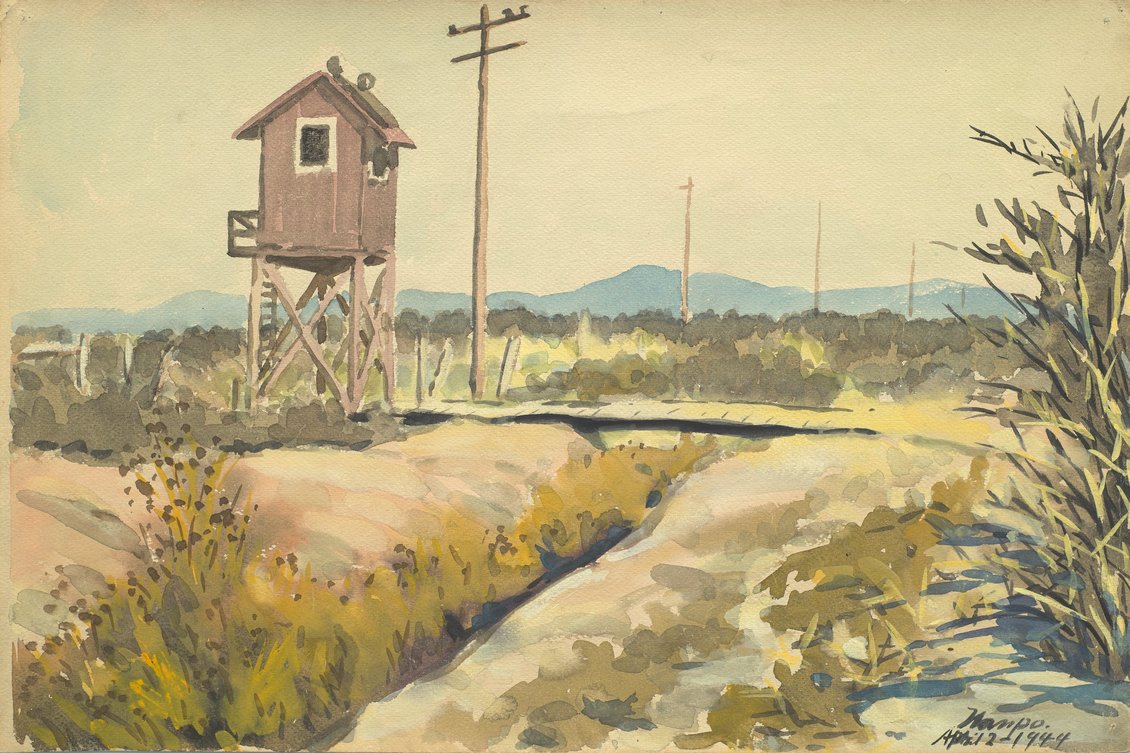
Image credit: Chikaji Kawakami, Untitled (The Guard Tower), 1944
Related Pages
- Under the Guard Tower: The Watercolors of Chikaji Kawakami
- Under the Guard Tower Module 1 / Depicting Life at the Camps
- Under the Guard Tower Module 2 / Self-Representation
- Under the Guard Tower Module 3 / The Killing of James Wakasa
- Under the Guard Tower Module 4 / Nature and Memory
- Under the Guard Tower Module 5 / Gardening and Nourishment
- Under the Guard Tower Module 6 / The Role of Art Schools
- Under the Guard Tower Module 7 / Oral Histories