
Under the Guard Tower Module 1 / Depicting Life at the Camps
Duration: 30 minutes
Learning Objective: Compare and contrast how Chikaji Kawakami and Miné Okubo depict everyday life in Japanese American internment camps, and analyze how factors such as age, gender, cultural background, and citizenship status shape artists’ perspectives on shared historical experiences.
→ Download all seven Under the Guard Tower Teaching Modules as a PDF
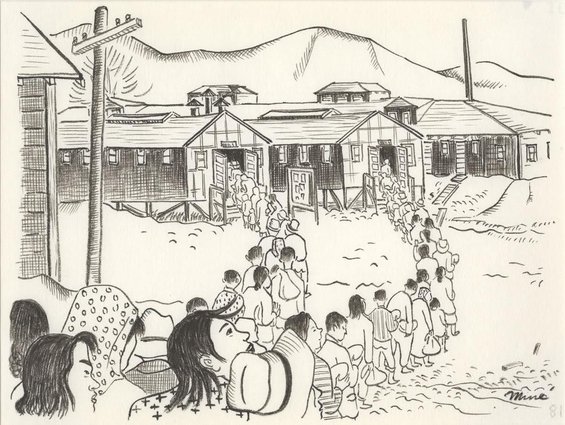
Like Chikaji Kawakami, Miné Okubo (1912-2001) taught at the internment art schools. She was born and raised in the United States. At the time of her incarceration, Okubo was at the beginning of a promising career as a visual artist. After completing her M.A. in Art at UC Berkeley, she received the Bertha Taussig Art Fellowship to study and paint art in Europe. The rise of WWII forced her to return to the United States without completing her fellowship. In 1946, Miné Okubo published Citizen 13660, a graphic memoir comprising 206 drawings of her experiences and observations of life at the camps. The book received the National Book Award in 1984, and in 1991, Okubo was awarded the Lifetime Achievement Award by the Women's Caucus for Art.
Okubo’s drawings provide an interesting comparison to Kawakami’s paintings, as both depict what they saw at the camps. The artists’ viewpoints, however, are influenced by age, gender, upbringing, and citizenship status. Kawakami was an Issei, a member of the first generation of Japanese outside Japan. He was brought up according to the norms of late 19th-century Japanese society. He was an older man, in his sixties, and as a Japanese citizen, he was viewed by American society as the enemy during WWII. Okubo, on the other hand, was a young woman, a Nisei, or second-generation person of Japanese American descent born and raised in the United States. She was fluent in English and acculturated to the American way of life. She was also a United States citizen.
→ At the gallery, find six paintings by Kawakami that depict everyday activities at Tanforan and at Topaz.
→ Flip through Miné Okubo's graphic memoir Citizen 13660, which describes everyday life at Tanforan and Topaz.
→ In small groups, answer the following questions about Kawakami and Okubo's images:
- What are the main differences in the way Kawakami and Okubo portray everyday life at the camps?
- What do you learn about life at the camps from each of the artists?
- How might the artists' gender, age, cultural background, and citizenship status affect the choices they made?
Image credit: Miné Okubo, Untitled, 1942-1944
Related Pages
- Under the Guard Tower: The Watercolors of Chikaji Kawakami
- Under the Guard Tower Module 2 / Self-Representation
- Under the Guard Tower Module 3 / The Killing of James Wakasa
- Under the Guard Tower Module 4 / Nature and Memory
- Under the Guard Tower Module 5 / Gardening and Nourishment
- Under the Guard Tower Module 6 / The Role of Art Schools
- Under the Guard Tower Module 7 / Oral Histories