
Under the Guard Tower Module 2 / Self-Representation
Duration: 60 minutes
Learning Objective: Evaluate how artists such as Chikaji Kawakami and Miné Okubo use self-representation to challenge propaganda, and examine how artistic choices can function as acts of resistance, identity formation, and testimony.
→ Download all seven Under the Guard Tower Teaching Modules as a PDF
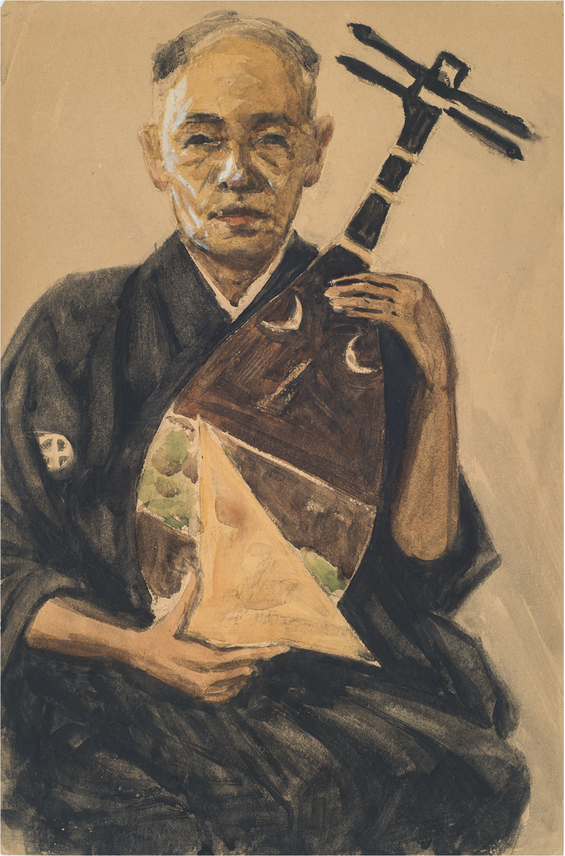
After the attack on Pearl Harbor in 1941, the United States launched a widespread propaganda campaign against Japan that relied heavily on racist stereotypes. Many posters and cartoons portrayed Japanese people as weak, animal-like, or subhuman to promote American superiority and unity. These images encouraged public support for the war effort but also reinforced harmful racial attitudes on the home front. Well-known figures such as Dr. Seuss contributed to this propaganda, though he later rejected these views. Meanwhile, the artists at the Japanese internment camps made careful, deliberate choices when composing self-portraits that combated this propaganda.
→ Read this article about anti-Japanese propaganda circulated during wartime by the United States government. Printed copies are available in the gallery.
→ Find and closely observe Kawakami's self-portrait. How is he positioned? How is he dressed? What is he doing?
→ Keeping in mind the images circulating about the Japanese during WWII and the way Kawakami chose to represent himself in his portrait, answer the following questions:
- What image do you think Kawakami wants to project of himself by making these choices?
- Knowing that this was one of the first paintings he did after being incarcerated, and that all aspects of Japanese culture were prohibited during the war, how would you interpret this painting? Explain your reasoning.
→ Watch this video about Miné Okubo's graphic memoir Citizen 13660.
→ Flip through Citizen 13660, and choose one panel to observe closely. Reflect on the following questions:
- How does Okubo depict herself? How is she positioned? What is she doing?
- Does this approach empower her voice? Does the role of being a witness strengthen or weaken her denunciation of the internment?
- How does Okubo’s approach to self-representation compare to Kawakami's?
For Further Research
🌐 Gesensway, D., & Roseman, M. (1987). Miné Okubo. In Beyond words: Images from America's concentration camps (pp. 66–74). Cornell University Press.
Lampert, N. (2015). The visual politics of Miné Okubo. In A people's art history of the United States: 250 years of activist art and artists working in social justice movements (pp. 177–187). New Press.
Miné Okubo. (2002). Citizen 13660. University Of Washington Press.
Robinson, G. (2008). Birth of a citizen: Miné Okubo and the politics of symbolism. In G. Robinson & E. Tajima-Creef (Eds.), Miné Okubo: Following her own road. University of Washington Press.
🌐 🎦 UNBOXED: Miné Okubo’s masterpiece: The art of Citizen 13660 [Video]. YouTube.
Image credit: Chikaji Kawakami, Self Portrait, n.d.
Related Pages
- Under the Guard Tower: The Watercolors of Chikaji Kawakami
- Under the Guard Tower Module 1 / Depicting Life at the Camps
- Under the Guard Tower Module 3 / The Killing of James Wakasa
- Under the Guard Tower Module 4 / Nature and Memory
- Under the Guard Tower Module 5 / Gardening and Nourishment
- Under the Guard Tower Module 6 / The Role of Art Schools
- Under the Guard Tower Module 7 / Oral Histories