
Under the Guard Tower Module 3 / The Killing of James Wakasa
Duration: 30 minutes
Learning Objective: Analyze and compare multiple artistic representations of the death of James Wakasa to understand how historical events can be interpreted differently through art, and evaluate how cultural perspective, creative style, and intended audience shape the meaning and impact of visual responses to injustice and violence.
→ Download all seven Under the Guard Tower Teaching Modules as a PDF
![Mine Okubo, Untitled [Memorial service for James Wakasa, Central Utah Relocation Project, Topaz, Utah]. 1942-1944](https://storage.googleapis.com/ccaportal-prod/images/o3.width-565.jpg)
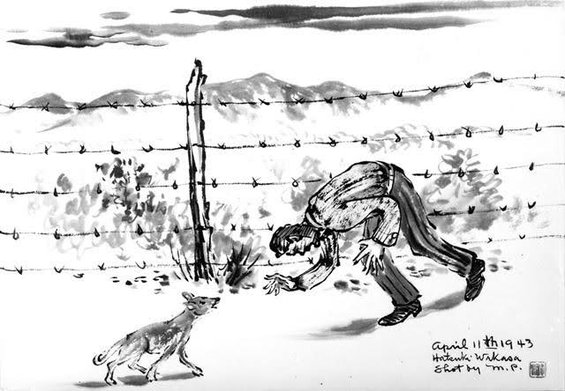
On April 11, 1943, James Wakasa, an elderly man, was shot and killed by a guard at Topaz, an event that horrified the community. Prior to the shooting, internees had expressed their fears of the guards who had exhibited strong anti-Japanese feelings towards them. The guards were soldiers who had been given a reprieve from fighting in the Pacific. Wakasa, who was semi deaf, had wandered near the fence following his dog and didn’t hear the soldier’s warning before the shooting. The soldier claimed that Wakasa had attempted to escape. The evidence showed, however, that Wakasa had been killed inside the fence, and the bullet had hit him from the front.
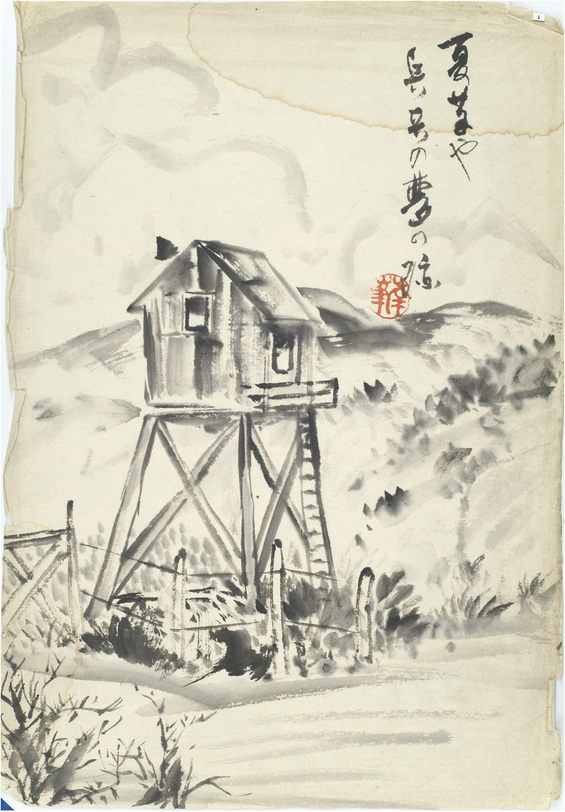
Chikaji Kawakami, Chiura Obata, and Miné Okubo documented this tragic event. Chiura Obata portrayed the actual killing, and Miné Okubo created several panels of Citizen 13660 describing the funeral of James Wakasa and the emotional impact of this senseless killing on the lives of the internees.
Kawakami’s depiction of this tragic event appears to be more subtle. Among the several paintings he did of the guard tower, this painting stands out because it was made at the time of the killing and differs dramatically from the rest of his work in style and content. He uses a traditional Japanese style known as haiga, consisting of a haiku illustrated with sumi-e (black ink) painting. Kawakami included a well-known haiku written by Matsuo Basho, a 17th-century poet. The poem is a reflection on the futility of war and the death of soldiers. In this painting, Kawakami seems to address the senseless death of Wakasa and war itself.
→ Closely observe and compare the three different representations of this tragic event.
→ In small groups, answer the following questions:
- What are their similarities and differences?
- What are the strengths of each?
- Why do you think Kawakami used a style that only Japanese people or those who knew the culture well would understand?
Image credits, from top to bottom:
- Chikaji Kawakami, Untitled, n.d.
- Chiura Obata, Hatsuki Wakasa Shot by M.P., 1943
- Miné Okubo, Untitled [Memorial service for James Wakasa, Central Utah Relocation Project, Topaz, Utah], 1942–1944
Related Pages
- Under the Guard Tower: The Watercolors of Chikaji Kawakami
- Under the Guard Tower Module 1 / Depicting Life at the Camps
- Under the Guard Tower Module 2 / Self-Representation
- Under the Guard Tower Module 4 / Nature and Memory
- Under the Guard Tower Module 5 / Gardening and Nourishment
- Under the Guard Tower Module 6 / The Role of Art Schools
- Under the Guard Tower Module 7 / Oral Histories