

Under the Guard Tower Module 5 / Gardening and Nourishment
Duration: 30 minutes
Learning Objective: Analyze how gardening functioned as a means of physical sustenance, emotional comfort, and cultural continuity in the camps by interpreting Chikaji Kawakami’s artwork and connecting historical practices of food and cultivation to personal experiences of nourishment, memory, and well-being.
→ Download all seven Under the Guard Tower Teaching Modules as a PDF
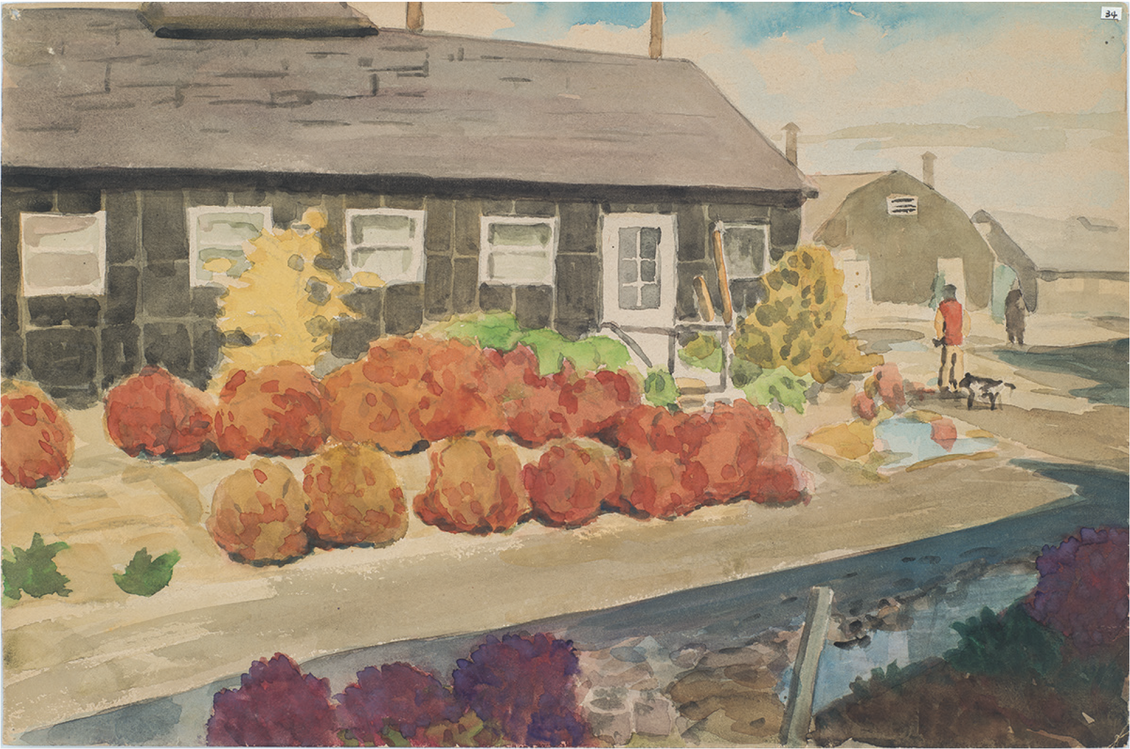
Gardening played an important role in daily life at the incarceration camps, especially for Issei (first-generation Japanese immigrants). Before World War II, many Issei worked as gardeners or agricultural laborers; by 1940, approximately 43% were employed in gardening and 26% in agricultural work. These skills carried over into camp life, where both vegetable and ornamental gardens were created despite limited resources.
At the camps, gardens served multiple purposes. Vegetable gardens—often referred to as victory gardens during WWII—helped supplement camp rations and allowed internees to prepare familiar foods, offering physical nourishment and emotional comfort. Ornamental gardens, on the other hand, recreated familiar landscapes and aesthetics. Both types of gardens promoted a sense of community, pride, and healing.
→ Carefully observe Chikaji Kawakami's painting of a vegetable (victory) garden. Pay attention to details such as composition, scale, human activity, and the relationship between people and the land.
→ In small groups, reflect on the following questions:
- How does gardening function as a form of both physical survival and emotional support for the internees?
- What values or feelings—such as care, patience, community, or resilience—do you see represented in this image?
- Why might gardening have been especially meaningful for Issei at the camps?
- Have you ever relied on specific foods to feel comforted or grounded, especially during times of stress or displacement? What kinds of foods were they, and why were they important to you? Have certain plants, gardens, or natural spaces ever given you a sense of familiarity or well-being? How?
→ Write a short paragraph or create a small sketch that reflects your own experiences with food, plants, and/or community.
For Further Research
🌐 Chiang, C. Y. (2018). Nature behind barbed wire: An environmental history of the Japanese American incarceration. Oxford University Press.
Helphand, K. I. (2006). Stone gardens: Japanese American internment camps, 1942–45. In Defiant gardens: Making gardens in wartime. Trinity University Press.
🌐 Limerick, P. N. (1992). Disorientation and reorientation: The American landscape discovered from the West. The Journal of American History, 79(3), 1021–1049.
🌐 Matsumoto, N. (2019, May 15). Art and the creation of a resilient Japanese spirit. PBS SoCal.
Murase, M. (2009). Through the seasons: Japanese art in nature. Yale University Press.
Image credit: Chikaji Kawakami, Untitled, n.d.
Related Pages
- Under the Guard Tower: The Watercolors of Chikaji Kawakami
- Under the Guard Tower Module 1 / Depicting Life at the Camps
- Under the Guard Tower Module 2 / Self-Representation
- Under the Guard Tower Module 3 / The Killing of James Wakasa
- Under the Guard Tower Module 4 / Nature and Memory
- Under the Guard Tower Module 6 / The Role of Art Schools
- Under the Guard Tower Module 7 / Oral Histories