
Under the Guard Tower Module 6 / The Role of Art Schools
Duration: 45 minutes
Learning Objective: Analyze artworks created in Japanese American incarceration camps to understand how artistic practice can function as a form of personal agency and community-building during times of trauma.
→ Download all seven Under the Guard Tower Teaching Modules as a PDF
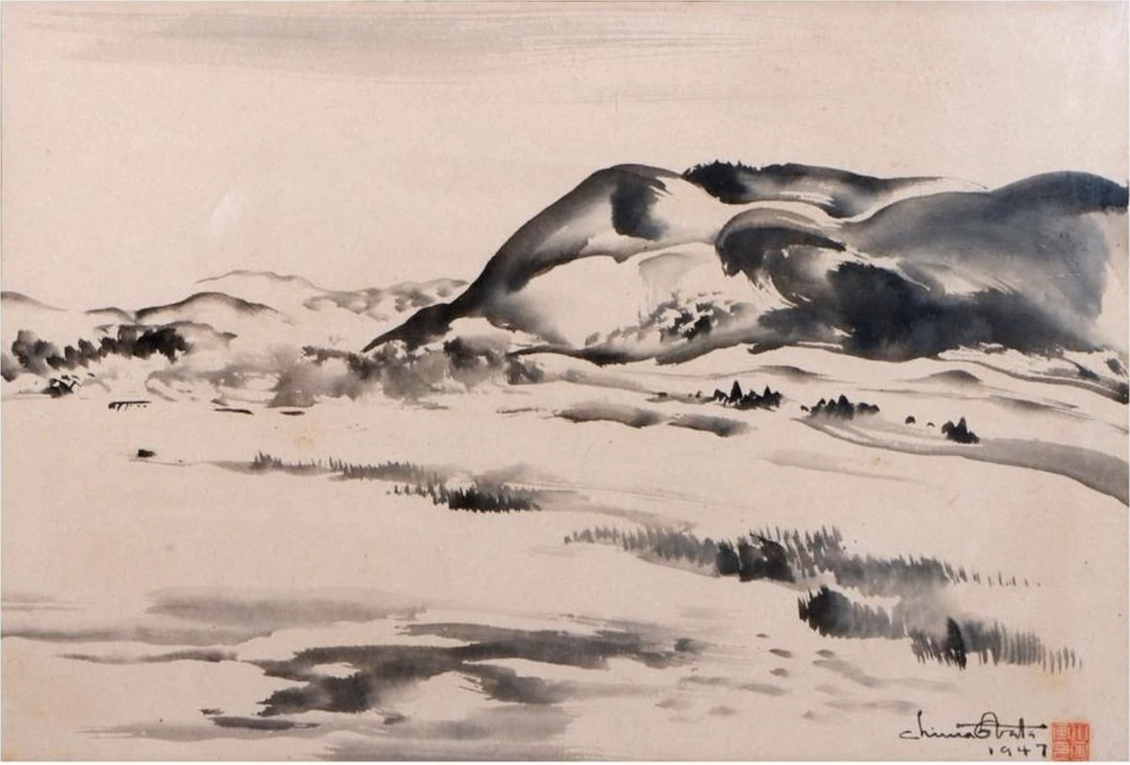
Chiura Obata created and directed highly successful art schools at the Tanforan and Topaz incarceration camps during World War II. He believed that art could help heal the emotional and spiritual harm caused by forced internment. Remarkably, Obata founded the first art school at Tanforan just three weeks after detainees arrived.
The schools offered classes ranging from elementary to university level and were taught daily by 17 instructors. Courses were grouped into three main areas: Fine Arts, Commercial Art, and Artistic Techniques. When internees were transferred to the Topaz camp, the art schools continued there as well.
Obata eventually left Topaz after being attacked by fellow inmates who interpreted his closeness to the camp authorities as evidence that he was a collaborator. George Hibi later became director and led the art schools until shortly before the camps closed.
Art classes and exhibitions—both inside and outside the camps—played an important role in improving morale. They gave internees opportunities for recreation, self-expression, and serious learning. Some students even went on to become professional artists after the war, including Taneyuki Harada and Kay Sekimachi.
→ Select 1–3 artworks in the exhibition for close observation and reflect privately on the following questions:
- What mood or emotions does this artwork suggest? What visual elements give you that impression?
- How does the artist depict the camp environment—harsh, calm, or something else?
- What might this artwork tell us about the artist’s inner life or coping strategies?
- How could making this artwork have helped the artist regain a sense of control or dignity?
- Do you see evidence of hope in this artwork? Where?
→ In small groups, answer the following questions:
- Why do you think creating and studying art helped raise the morale of people living in the camps?
- What emotions or needs might art have addressed that daily life in the camps could not?
- What role can art schools or creative spaces play when communities are experiencing trauma or hardship?
- Do you think it is possible to cultivate hope through making art? Why or why not?
- Can you think of other examples where creativity helped people endure difficult situations?
For Further Research
🌐 Hibi, H. (2004). Peaceful painter: Memoirs of an Issei woman artist. Heyday Books.
Higa, K. M. (1992). The view from within. In The view from within: Japanese American art from the internment camps, 1942–1945. Japanese American National Museum; UCLA Wight Art Gallery; UCLA Asian American Studies Center.
Hill, K. K. (Ed.). (2000). Chiura Obata's Topaz moon: Art of the internment. (T. A. Burgard, Intro.; R. Asawa, Foreword). Heyday Books.
🌐 Hirasuna, D. (2016). All that remains: The legacy of the World War II Japanese American internment camps.
Yamashita, K. T. (2017). Letters to memory. Coffee House Press Books.
🌐 Limerick, P. N. (1992). Disorientation and reorientation: The American landscape discovered from the West. The Journal of American History, 79(3), 1021–1049.
🌐 Matsumoto, N. (2019, May 15). Art and the creation of a resilient Japanese spirit. PBS SoCal.
Murase, M. (2009). Through the seasons: Japanese art in nature. Yale University Press.
🌐 Ueno, R. (2019, September 10). One spot of normalcy: Chiura Obata’s art schools. Archives of American Art, Smithsonian Institution.
Image credit: Chiura Obata, Mountain Landscape, 1947
Related Pages
- Under the Guard Tower: The Watercolors of Chikaji Kawakami
- Under the Guard Tower Module 1 / Depicting Life at the Camps
- Under the Guard Tower Module 2 / Self-Representation
- Under the Guard Tower Module 3 / The Killing of James Wakasa
- Under the Guard Tower Module 4 / Nature and Memory
- Under the Guard Tower Module 5 / Gardening and Nourishment
- Under the Guard Tower Module 7 / Oral Histories